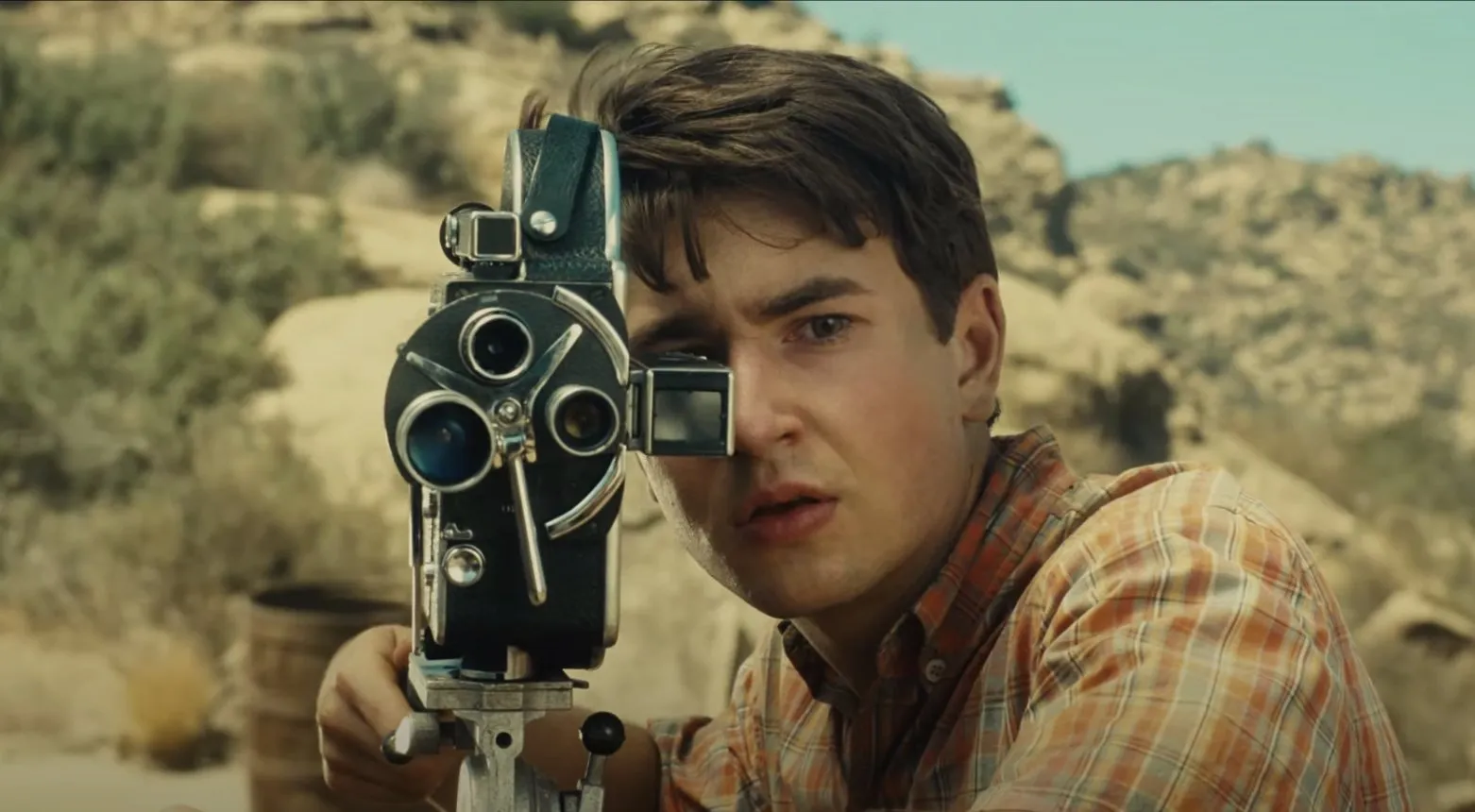
In investor Byron Wien’s “20 Life Lessons,” he says, “When meeting someone new, try to find out what formative experience occurred in their lives before they were 17. It is my belief that some important event in everyone’s youth has an influence on everything that occurs afterwards.” And while that may or may not always be true, The Fabelmans gives us some ideas of early life events that formed Spielberg’s unique perspective and perhaps some insight into his beliefs about art. In typical Spielberg style, the film does not explicitly espouse a particular point of view or direct the viewer to a single logical conclusion, but rather shines a light on the nuances and questions of human life, leaving the viewer to draw their own conclusions. The Fabelmans is intriguing, funny, and vulnerable, but it also prompts reflection on the fundamental nature of art and the artist.
The film tells the story of Sammy Fabelman, a Jewish boy who becomes obsessed with filmmaking. His father, a brilliant engineer, sees little value in his son’s hobby, while his mother, a concert pianist, supports her son’s filmmaking pursuits. While the film is a compelling watch overall, two interesting ideas stick out for me. The first is about the relationship between art and reality, and the second is about the vocation of the artist.
The relationship between art and reality
Art is a human creation that exists within a reality not of human making. When people experience art, they perceive it through the lens of their existing understanding of the world – their mental model of reality. Yet the act of experiencing art is not passive; art itself becomes an input that shapes and refines that mental model. Art has power because it presents a particular vision of reality and, in doing so, influences how the viewer perceives the world. For example, the European gothic cathedrals were designed to evoke in the worshipper feelings of awe and humility lifting their minds to heaven and making them realize the power and majesty of God. Art can guide the viewer to a more accurate perception of reality by presenting more explicitly or clarifying elements of reality, or it can distort the viewer’s mental model by misrepresenting the truth about the way things are.
However, important to note, art doesn’t have to be literally true to help us better understand true things. Picasso, of all artists, said “Art is a lie that makes us realize truth, at least the truth that is given us to understand.”
The Fabelmans draws a clear distinction between art and reality and illustrates the power and the danger of art being used to convey and interpret truth.
In one example, Sammy Fabelman’s parents – Burt, the logical engineer, and Mitzi, the sensitive artist – never see eye to eye, but it isn’t until editing film of a recent family camping trip that Sammy Fabelman sees that his parents’ relationship is less solid than he previously realized. Watching and rewinding the film over and over again at several different moments, Sammy sees that his mother and his father’s best friend are emotionally involved with each other. After his filmmaking hobby first leads Sammy to this realization, he begins to notice Mitzi’s emotional affair happening right in front of him. This realization causes a rift between Sammy and his mother until, when Sammy plays the film of the camping trip for her, she breaks down in tears as the full import of her actions is made suddenly clear to her. The friendship she thought she could maintain with Burt’s best friend while remaining a devoted wife, she sees suddenly for what it is.
In this instance, Sammy’s art is an instrument revealing and making clear truths about reality. Both Sammy and his mother better understand the reality of their situations and relationships after engaging with Sammy’s film.
In another example, Sammy volunteers to make a video of his school’s senior ditch day at the beach, which later gets watched by the school at the prom. In Sammy’s final cut, two boys feature prominently. One boy, Chad, has consistently bullied and terrorized Sammy, while the other, Logan, perhaps less inclined to be vicious, began to treat Sammy poorly after Sammy revealed to his girlfriend that he had cheated on her, causing their breakup. In his film, Sammy makes Chad seem pathetic by prominently featuring shots of him getting rejected and walking alone down the beach. In contrast, Sammy shows Logan as almost godlike, winning sporting activities and bathing in the adulation of his peers awash in golden California sunlight. But more surprising than the positive light in which Sammy portrays Logan is the way that Logan reacts. In the school hall outside the prom, angry and confused, Logan confronts Sammy. He asks Sammy why he made him look so impressive. And then Logan breaks down: “What’s the matter with you? I’ve been a total asshole to you … then you go and make me look like … this golden kind of thing.” And then in a surprising moment of vulnerability, “You make me feel like I’m some kind of failure, or a phony, or like I’m supposed to be some guy I’m never gonna be … You took that guy … and you put him up there on that screen and told everyone, that’s me. And that’s not me.”
Here, Sammy puts forward a highly edited interpretation of reality in his film and experiences unintended consequences. Rather than being particularly grateful to Sammy or happy about the film, even though it causes his reunion with the jilted girlfriend, Logan is hurt and overwhelmed by the version of reality the film portrays. Logan is shown as a sort of superman, a man he feels he can never become. While the class’s admiration for him has increased due to the film’s presentation of his athletic prowess, Logan sees only a version of himself that he can never live up to.
The artist’s vocation
Spielberg also introduces some interesting ideas around the vocation of an artist and how that calling can impact familial relationships.
In one of the film’s ongoing storylines, Sammy’s mother, Mitzi, and father, Burt, butt heads over Sammy’s moviemaking and their approach to life in general. Burt is a logical career-oriented engineer. Mitzi is more emotional and artistic, and we learn that she put aside a promising career as a musician when she got married. Their different talents and inclinations lead to Mitzi saying, “In this family, it’s the scientists vs. the artists. Sammy’s on my team, he takes after me, except he’s got real talent.” By the end of the film, their differences have led to divorce.
In a sequence of scenes somewhat digressive from the film’s overall narrative flow, Sammy’s Uncle Boris comes to stay with the family briefly after the death of Sammy’s grandmother. Uncle Boris is the black sheep of the family who ran away to be a circus performer, a job he saw as art. Uncle Boris tells Sammy, “Family, art, it will tear you in two … Art will give you crowns in heaven and laurels on earth, but it will tear your heart out and leave you lonely.”
It’s almost as if Spielberg is saying that to create great art, to be truly great, the artist must give himself completely to his craft. There is no half-hearted, semi-dedicated great artist. And while a tumultuous family relationship isn’t a requirement to be a great artist, many artists did have troubled marriages and dramatic relationships. Spielberg himself is once divorced.
But again, Spielberg never explicitly endorses any specific point of view. He tells his story, full of expression and emotion, and lets the viewer reach their own conclusions. Questions about how the artist should wield his creative power or how the artist should balance a commitment to their art and their relationships go unanswered.