I’ve always been interested in how Ronald Reagan managed to transform a nation despite lacking skills or interest in administration. This essay is an attempt to answer that question.
President #40:
In 1980, the United States elected a new president in a landslide, 489-49 electoral votes. However, this new president – who would later attain something close to mythic status within the Republican party – remains, when compared to his legacy, something of an enigma. He put forward a bold vision for America at home and abroad, presided over a number of significant political achievements, and helped shift the country decisively to the right, yet on close inspection, Ronald Reagan is not the sort of figure one might expect to become a transformative and then a legendary leader. Reagan the man seems an unlikely source of Reagan the myth. At first glance, Reagan seems to be more show than substance, more talking head than capable executive.
Reagan was not known as a particularly tireless worker and was sometimes described as lazy. He avoided details, preferring to stay high level and speak in sweeping generalities. Critics often described him as incurious and overly reliant on rehearsed anecdotes rather than careful analysis. He disliked personal confrontation, studiously avoiding it, and was famously reluctant to fire members of his administration. He failed to oversee his staffers leaving much of the day-to-day oversight of government to subordinates. He had few close friends beyond perhaps his wife, Nancy, and was generally considered distant and aloof.
Yet, Ronald Reagan is widely regarded as one of the most successful and transformative presidents of the modern era. He is often held up as the quintessential Republican leader, a political figure whose influence reshaped the party and the country. His legacy continues to loom large, and he is frequently credited with advancing an agenda of tax cuts, a more assertive American foreign policy, and a renewed confidence in American power. The myth of his success has only grown since he left office. Even Barack Obama acknowledged Reagan’s political effectiveness, declaring him a transformational president who “changed the trajectory of America.”
Here is some of his accomplishments to illustrate the magnitude of what he accomplished:
- Passed the Economic Recovery Tax Act of 1981, which included the largest tax cuts in the postwar period, the Tax Equity and Fiscal Responsibility Act of 1982, and the Tax Reform Act of 1986. These bills restructured the tax code resulting in changes like the top marginal tax rate on individual income falling from 70% to 28%.
- Often given credit for bringing and end to the cold war, Reagan negotiated arms reductions treaties (e.g., 1987 Intermediate-Range Nuclear Forces Treaty) and implemented the “Reagan Doctrine” of support for anti-communist movements around the world with the goal of reducing Soviet influence
- Oversaw a major peacetime military buildup and launched the Strategic Defense Initiative (SDI)
- Appointed a large number of conservative federal judges including Antonin Scalia
- Presided over a prolonged period of economic recovery with sustained growth and inflation dropping from 13.5% in 1980 to 4.1% by 1988
- Won re-election in 1984 by an even greater margin than in 1980, winning 525 electoral votes, 49 states, and 58.8% of the popular vote. He ended his presidency with an approval rating of 63% in December 1988.
So how was Ronald Reagan such a successful president? How did he manage to achieve so many of his political goals despite being such a poor administrator?
The answer lies largely in his exceptional ability to communicate. Ronald Reagan, known as “The Great Communicator,” was uniquely able to communicate his vision to both his staff and to the American people. There was no confusion or ambiguity on where Reagan stood or what he wanted. Despite his weaknesses as an administrator, Reagan’s ability to inspire, provide clarity of purpose, dispel doubt, and maintain a steady message formed the foundation of his leadership. Four qualities in particular defined Reagan’s communication: clarity, consistency, conviction, and optimism.
Clarity
Reagan’s first strength as a communicator was clarity. It was always clear what Ronald Reagan wanted and why he wanted it. He possessed an unusual ability to distill complex geopolitical and economic ideas into language that ordinary Americans could easily grasp.
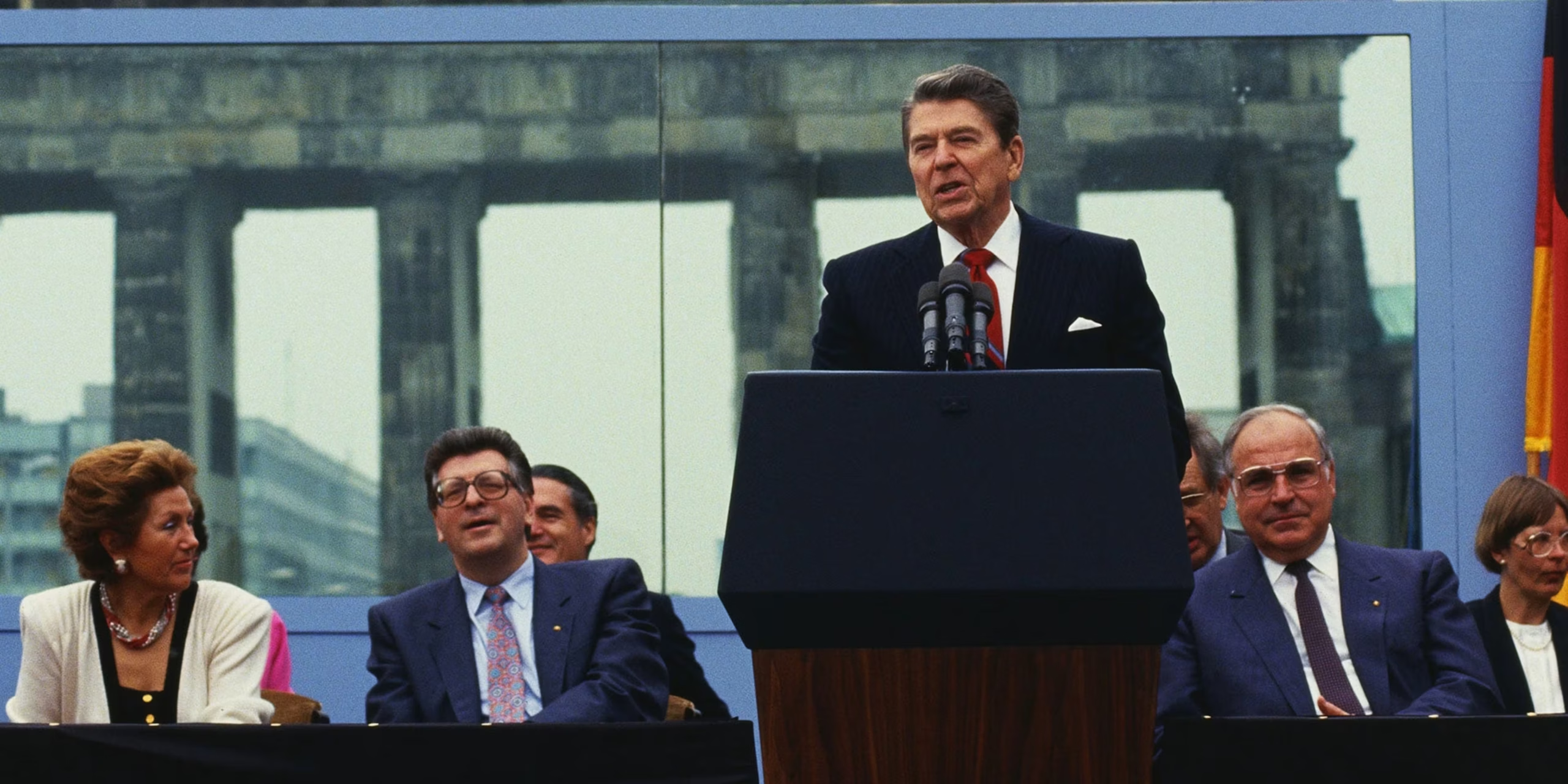
Reagan did not hedge or obscure his meaning by diving into policy nuance. In 1983, he described the Soviet Union as an “evil empire,” framing the Cold War conflict not merely as a geopolitical rivalry but as a moral struggle. Perhaps the most famous example of Regan simplifying complex geopolitical politics into a simple idea is his 1987 speech at the Berlin Wall where he quotably said: “Mr. Gorbachev, tear down this wall.” In these seven words, Reagan framed the entire moral and political tension of the cold war into a single, specific demand.
Paradoxically, Reagan’s well-known lack of interest in policy detail may have strengthened the clarity of his communications. He was not a policy technician, nor did he dwell on granular specifics. His speeches rarely lingered on legislative complexities. Instead, Reagan spoke in broad, simple terms that avoided jargon and qualifications. Rather than explaining precisely how a policy would work, he articulated the principles behind it in language that citizens could easily understand and rally behind.
This approach allowed Reagan to communicate a straightforward vision: lower taxes and smaller government at home, defending democracy and rolling back communism abroad. By consistently presenting these ideas in clear and accessible terms, Reagan ensured that his message could be understood not only within his administration but also by the broader American public. His clarity made his vision easy to recognize and difficult to misunderstand, and it formed the foundation of his effectiveness as a communicator.
Consistency
Reagan’s second strength as a communicator was consistency. He did not simply stay on message during a speech or a campaign – he stayed on message for decades. Whether speaking to his staff, addressing the nation, or negotiating with foreign leaders, the central themes of his rhetoric rarely changed. At home, he emphasized lower taxes and the dangers of excessive government. Abroad, he spoke consistently about the threat of communism and the importance of defending freedom.
This consistency even extended to the anecdotes he used to illustrate his points. Reagan was known for repeating the same stories in speeches even after journalists had shown them to be factually questionable. A more cautious politician might have quietly retired such anecdotes once they were challenged. Reagan often continued to use them. In a conventional sense, this was a flaw, but it reveals something important about how Reagan communicated. He was less concerned with precise data or technical nuance than with conveying a principle. The anecdote served as a vehicle for the larger idea he wanted to communicate, and that idea remained constant. Over time, this unwavering repetition reinforced a clear and stable message that audiences came to recognize and in many cases support.
It’s also interesting to note that Reagan’s consistency in communicating his goals persisted despite his policymaking pragmatism. While he often compromised on the specific terms of legislation or treaties – accepting less sweeping change than his rhetoric suggested – his public message rarely softened. Reagan continued to advocate transformational goals, using his speeches to shape public opinion and point the country toward his broader vision. For example, even while condemning the Soviet Union as an “evil empire,” Reagan negotiated with Mikhail Gorbachev to eliminate an entire class of nuclear weapons in the Intermediate-Range Nuclear Forces Treaty of 1987. Similarly, after championing major tax cuts through the Economic Recovery Tax Act of 1981, he later agreed to revenue increases in the Tax Equity and Fiscal Responsibility Act of 1982. In each case, Reagan proved flexible on policy details while remaining unwavering in the principles he communicated to the public.
Conviction
Reagan’s third strength as a communicator was conviction. He did not simply speak clearly and consistently – he spoke with complete certainty about the ideas he believed in. Reagan viewed the world through a moral framework that rarely wavered: America represented freedom and opportunity, communism represented oppression, and in the long run freedom would prevail. This clarity of belief gave his words a sense of authenticity that purely tactical political messaging rarely achieves.
Because Reagan believed so strongly in this worldview, he was often willing to say things that made his own advisers uncomfortable. When drafting his 1987 Berlin speech, members of the State Department urged him to remove the line “Mr. Gorbachev, tear down this wall,” fearing it would provoke the Soviet leadership. Reagan insisted on keeping it. Earlier in his presidency, he described the Soviet Union as an “evil empire,” despite diplomatic concerns about the bluntness of the phrase. He also pursued the Strategic Defense Initiative, a missile defense program that many experts dismissed as unrealistic.
In each of these cases, Reagan showed little concern about appearing naïve or overly idealistic. What mattered to him was stating plainly what he believed to be true. This certainty gave his rhetoric unusual weight. Audiences can often sense when a political leader is speaking strategically rather than sincerely. With Reagan, there was rarely doubt that he believed what he was saying. That conviction proved contagious, reinforcing the perception that he was a leader guided by genuine beliefs rather than calculated messaging.
Reagan’s first career was as an actor, but ironically he was not a very good one. He really only excelled at playing one type of role: characters who were very much like himself. Reagan had a limited ability to embody characters with beliefs and personalities different from his own. While this constrained his potential as an actor, he would later excel in his chosen political career, where he was effectively in charge of writing the script. As president, Ronald Reagan played himself to perfection with the full conviction of his beliefs.
Optimism
Underlying Reagan’s clarity, consistency, and conviction was a deep current of optimism. His famous 1984 campaign message, “Morning in America,” was not only a slogan but a reflection of his broader outlook. Reagan consistently presented the future as improved but attainable. In his speeches, he painted a picture of what America could become and offered a vision toward which the country could strive. By articulating that vision clearly and repeatedly, he helped shape what Americans believed was possible.
Reagan was relentlessly positive, rarely appearing discouraged and seldom accepting the idea that a goal could not be achieved. This outlook was reinforced by an easy humor that became one of his defining personal traits. Reagan was known for constantly telling jokes – in press conferences, in private meetings, and even in moments of crisis. After surviving an assassination attempt in 1981, he famously joked to the surgeons preparing to operate on him, “I hope you’re all Republicans.” Rather than a calculated political strategy, his humor was a reflection of Reagan’s optimist outlook on life.
This optimism appeared most clearly in Reagan’s approach to the Cold War. When Reagan entered office, the prevailing view in Washington was that the conflict with the Soviet Union could only be managed, not won. Reagan rejected that assumption. He believed the United States and the ideals it represented would ultimately prevail, and he said so openly. By speaking about victory in confident and hopeful terms, he made an outcome that once seemed unrealistic appear plausible. His optimism communicated not only what he believed, but what he believed Americans themselves should believe. When the Soviet Union eventually collapsed, Reagan would be given a lot of credit for helping to cause that collapse.
Communication as the key to Reagan’s successes:
Reagan’s success as a leader, despite his administrative weaknesses, derived from his communicative abilities. Because he articulated his goals with such clarity, consistency, conviction, and optimism, those around him rarely had to wonder what direction he wanted the country to move. Reagan set the vision – lower taxes, smaller government, renewed American strength abroad, and confidence in the nation’s future – but left his staff to determine the practical details of how to implement it. In this sense, Reagan functioned less as a manager than as a guide. His administration knew the destination even when the precise route was left unspecified.
Such a leadership style was not without its weaknesses. Reagan’s distance from the details of policy implementation and his reluctance to closely supervise subordinates sometimes created problems, most famously in the Iran–Contra affair. Such episodes revealed the risks of a leadership style that emphasized vision over oversight. Yet, these failures were exceptions rather than the defining feature of his presidency. In most cases, Reagan’s staff were able to translate his clearly communicated principles into concrete policy.
Ultimately, Reagan’s political success rested on the power of his communication. By consistently articulating a simple and compelling vision, he ensured that both his administration and the broader public understood the direction he intended to lead the country. Even when he left the mechanics of policy to others, the objectives remained unmistakable. Reagan governed not through detailed management, but through clarity of purpose – and that clarity proved powerful enough to shape policy, guide his administration, and leave a lasting imprint on American politics.
So what’s the takeaway for leaders?
The example of Ronald Reagan illustrates a broader point about leadership. Effective leadership is not determined solely by administrative skill or managerial abilities. While those qualities matter, leadership also depends heavily on communication. A leader must articulate a vision clearly enough that others understand the goals of the organization and can align their efforts toward achieving them. In many cases, the ability to communicate a vision of success may be the single most important factor in getting large groups of people to move in the same direction.
- Clarity: communicate the vision in simple terms
Leaders must make it unmistakably clear what the goal is and why it matters. When the objective is communicated in simple, understandable language, people across an organization can align their efforts toward the same outcome. - Consistency: repeat the message until it becomes the culture
A message delivered once is forgotten; a message repeated constantly becomes embedded. Consistent communication reinforces priorities and ensures people continue moving in the same direction. It’s impossible to communicate the vision too often. - Conviction: speak from your own deeply held beliefs
People can tell when a leader believes what they are saying. Communication backed by real conviction carries greater weight and inspires stronger trust and commitment. - Optimism: show your confidence of achieving the vision
Leaders must show that they believe success is possible. Belief in the possibility, or even inevitability of success, at the organizational level is downstream of the leader’s optimism.
Addendum:
Although this essay argues for the importance of communication in leadership, and I generally believe that leaders should spend more time on the story they are telling and the vision they are communicating, I do not want to discount the importance of administrative skill. For all of Ronald Reagan’s success, he also fell short of many of his goals. During his presidency, the national debt nearly tripled, rising from $907 billion in 1980 to $2.6 trillion by 1988; federal spending increased by 69 percent between 1981 and 1989; and the civilian federal workforce grew from 4.9 million to over 5.2 million. Had Reagan been a stronger administrator, he might have more fully achieved his objectives and avoided some of the scandals that occurred within his administration.
